

This past year marked my second time coaching the Ethics Bowl team at Northeastern State University, and it was one of the most meaningful experiences I’ve had as an educator.
What made this season especially significant was that every student on our team was competing in Ethics Bowl for the first time.
You can also read this article on my Substack, here.
What Is Ethics Bowl?
As someone who teaches business ethics, I’ve come to see Ethics Bowl as far more than a competition. It’s a space where students actively wrestle with the ethical dimensions of real issues: technology, healthcare, leadership, artificial intelligence, public policy, free speech, justice, and human dignity. These aren’t abstract topics in a textbook. They’re the questions shaping the world our students are stepping into.
For those unfamiliar with Ethics Bowl, it’s not about who argues the loudest or scores the most debate points. Teams are evaluated on the depth of their ethical reasoning, the clarity of their analysis, and the quality of their engagement with both the judges and the opposing team. Visit the Association for Practical and Professional Ethics for more information.
Specifically, students are scored on how well they:
- Identify the ethical dimensions of a case
- Apply ethical frameworks and reasoning
- Present thoughtful, nuanced arguments
- Respond to questions under pressure
- Engage opposing viewpoints with intellectual humility and respect
That last one matters more than people realize. The format is rooted in collaborative dialogue, not adversarial debate, which is honestly one of the main reasons I chose to coach it.
The Coaching Philosophy: Transformational Leadership from the Inside Out
My approach to coaching Ethics Bowl is grounded in transformational leadership, and it starts long before any competition.
I believe that before students can engage ethics well outwardly, they have to do some meaningful work inwardly first.
That begins with self-awareness. Understanding who you are, what you value, and the lenses through which you naturally interpret the world. But it also requires something harder: getting honest about how you respond when your views are challenged. Do you shut down? Get defensive? Dismiss the other perspective before you’ve genuinely considered it? These aren’t character flaws. They’re patterns, often deeply wired, and recognizing them is the starting point for growth.
This is where neuroscience enters the picture. Our brains are wired for self-protection. When our beliefs are challenged, the brain can register it as a threat and activate the same stress response systems that handle physical danger. The amygdala fires. Cortisol rises. The prefrontal cortex, responsible for our highest-order thinking, reasoning, and empathy, goes partially offline. In that moment, we are not at our best. We are at our most reactive.
Understanding that response, and learning to regulate it rather than react from it, is foundational to ethical engagement. Transformational leaders don’t suppress that response. They learn to recognize it, name it, and choose a different path forward. That is exactly what I was coaching these students to do.
Part of that work is learning to stay present in the moment. When you’re under pressure, the temptation is to spend most of your mental energy rehearsing your next response instead of genuinely listening to what’s being said right in front of you. Presence requires neurological regulation. It requires training yourself to stay grounded when the stakes feel high, to let another perspective land before you respond to it, and to trust that you don’t have to have all the answers immediately.
That kind of presence is harder than it sounds. And it’s one of the most transferable skills a student can develop, not just for Ethics Bowl, but for leadership, relationships, and life.
Traditional debate can train people to prepare their next response instead of genuinely listening to what’s being said right in front of them. Ethics Bowl demands something different. Students have to be fully in the room, engaged with the actual argument being made, willing to let it complicate their thinking before they respond.
Students were challenged to articulate their own positions clearly and to take seriously the perspectives that complicated or contradicted them. That tension, sitting with complexity rather than resolving it prematurely, is where real thinking happens. And it reflects real leadership far more accurately than performative argumentation ever could.
The Team Behind the Team: Shelby Hebard, MBA
Before I go any further, I want to give a very special acknowledgment to Shelby Hebard, an MBA student who stepped into the role of mentor and assistant coach this season.
Shelby brought something unique to this team: the perspective of someone who had recently been exactly where our students were, combined with the maturity to lead alongside them rather than over them. She understood what it felt like to navigate uncertainty, to sit across from judges, to hold a complex ethical position under pressure. And she used all of that to create an environment where students felt genuinely supported, intellectually challenged, and safe enough to grow.
Her investment in this team was consistent and real from August through the end of the season. Her leadership made a meaningful difference. I’m proud of the way she showed up for these students, and I’m grateful she chose to pour into this experience the way she did.
The Frameworks They Learned (And What They Really Learned)
Throughout the season, students learned to apply frameworks including:
- Utilitarianism — evaluating actions based on outcomes and the greatest good for the greatest number
- Deontology — focusing on duties, principles, and moral obligations regardless of outcome
- Virtue Ethics — emphasizing character and the kind of person one becomes through choices and habits
- Care Ethics — centering relationships, empathy, and our responsibilities toward others
- Rights-Based Ethics — considering individual rights, freedoms, and protections
- Justice-Based Ethics — examining fairness, equity, and how benefits and burdens are distributed
- Stakeholder Theory — analyzing how decisions affect all connected groups, not just those with positional power
But the frameworks were almost secondary to what I watched these students actually learn.
They learned how to slow down. How to ask better questions. How to stay intellectually engaged on emotionally difficult topics without shutting down or becoming reactive. They learned that slowing the brain’s threat response long enough to genuinely hear another perspective is itself a form of ethical practice. That’s the neuroscience of transformational leadership in action.
Over the course of the season, I saw them grow in confidence, communication, and genuine teamwork. And then they went out and competed.
The People Who Made It Happen: Meet the Team
Before I walk through the competition season, I want to take a moment to introduce the people behind it. Every one of these students brought something distinct and irreplaceable to this team, and they deserve to be seen individually, not just as a group result.
Reese came in with debate experience, and that background was evident from the start. But what impressed me most was how she used that foundation not to dominate the room, but to bring the team together. She articulated complex positions with clarity and precision, and consistently elevated the people around her.
Gabriela was the heartbeat of the team’s energy. She cheered everyone on with a genuineness that never felt performative, and at the same time, she was quietly stepping into new levels of her own confidence with every practice and every round. Watching her grow across the season was one of the real joys of coaching this group.
Abraham found his voice this year in a powerful way. He developed a real gift for providing sound, well-reasoned counterpoints that challenge an argument without dismissing it. In a format where engaging the opposing team thoughtfully is part of your score, that skill matters enormously.
Bri was the team’s organizational backbone. She kept the back end running, made sure everyone was prepared, and held things together in ways that do not always get noticed but absolutely get felt. And when it was her turn to step to the table and speak, she delivered.
Jo brought humanity to every discussion. She had a gift for storytelling that grounded abstract ethical arguments in real human experience, and she drew on a depth of personal and professional insight that made her contributions feel authentic and weighty. Ethics is ultimately about people, and Jo never let the team forget that.
Sam was passionate about her cases in a way that was impossible to miss. That kind of genuine investment in the material is something you cannot manufacture. When a student genuinely cares about what they are arguing, it comes through, and for Sam, it was evident. Her passion shone in the moment when it mattered most.
Ashtynn had one of the most demanding skills to develop in Ethics Bowl: the ability to craft a thoughtful, organized response in minutes — sometimes less — on a case you were not as familiar with. In competition, you do not know which of nine possible cases you will receive until you sit down at the table. Ashtynn consistently rose to that challenge, demonstrating the kind of calm, focused thinking under pressure that is hard to teach.
These seven students, as first-time competitors, built something together that I will not forget. Each one grew. Each one contributed. And each one left this season different than they arrived.
October 2025: Oklahoma Statewide College Ethics Bowl

Before I share our results, I want to take a moment to honor something significant.
The Oklahoma Statewide College Ethics Bowl has been organized and championed by Oklahoma Schools of Character for over two decades. Their commitment to building ethical reasoning, civil dialogue, and character development in students across the state has been nothing short of extraordinary. They created a space where college students could wrestle with hard questions in a format that rewarded depth over volume and humility over performance.
This past year was their final year hosting the competition, and that deserves to be acknowledged with the gratitude it’s due. The foundation they built made everything our team experienced possible. If you want to learn more about their work and legacy, you can visit them at okcharacter.org.
Thank you, Oklahoma Schools of Character. What you built mattered.
Our team finished 4th in the state competition, with all three Oklahoma State University teams taking the top spots. For a first-year team going up against more experienced programs on a stage that Oklahoma Schools of Character helped build for more than twenty years, that result was something to be genuinely proud of.
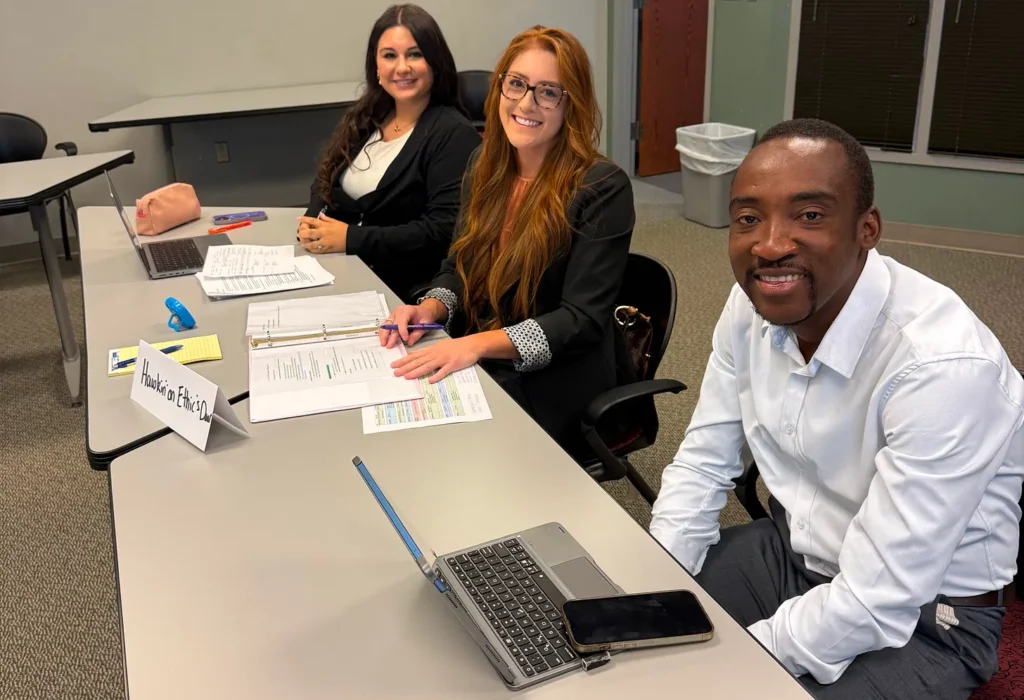
November 2025: Texas Regional Ethics Bowl at St. Mary’s University
We also competed at the regional competition hosted by St. Mary’s University in San Antonio against some of the strongest teams in the region, 14 teams total. Our students represented NSU with professionalism, intellectual humility, and integrity throughout the entire experience. Watching them walk into that room as first-time competitors and hold their own against programs with years of preparation behind them was one of those moments you carry with you for a long time as an educator.

I also want to give a special shoutout to Dr. Edward Lunney, whose presence and support in San Antonio meant more than he probably knows. Having a colleague show up, cheer the team on, and invest in the experience alongside us added something to that day that competition results alone never could. That kind of collegial investment in students is exactly what builds the kind of culture that makes experiential learning sustainable.
The Recognition That Meant the Most
This season brought recognition that went far beyond what any of us anticipated when we started in August.

The NSU Ethics Bowl team was named Student Organization of the Year at Northeastern State University. Let that land for a moment. A first-year team, made entirely of first-time competitors, earned the top student organization honor at their institution. That is not a small thing.
At the annual end-of-semester event, each student was presented with an individual plaque by Dr. Janet Buzzard, a consistent champion and supporter of this program over multiple years. I want to give her genuine thanks here, because programs like Ethics Bowl do not sustain themselves. They require leaders who believe in the value of what students are doing and who show up year after year to affirm it. Dr. Buzzard has been that person for this team, and it matters more than she may know.
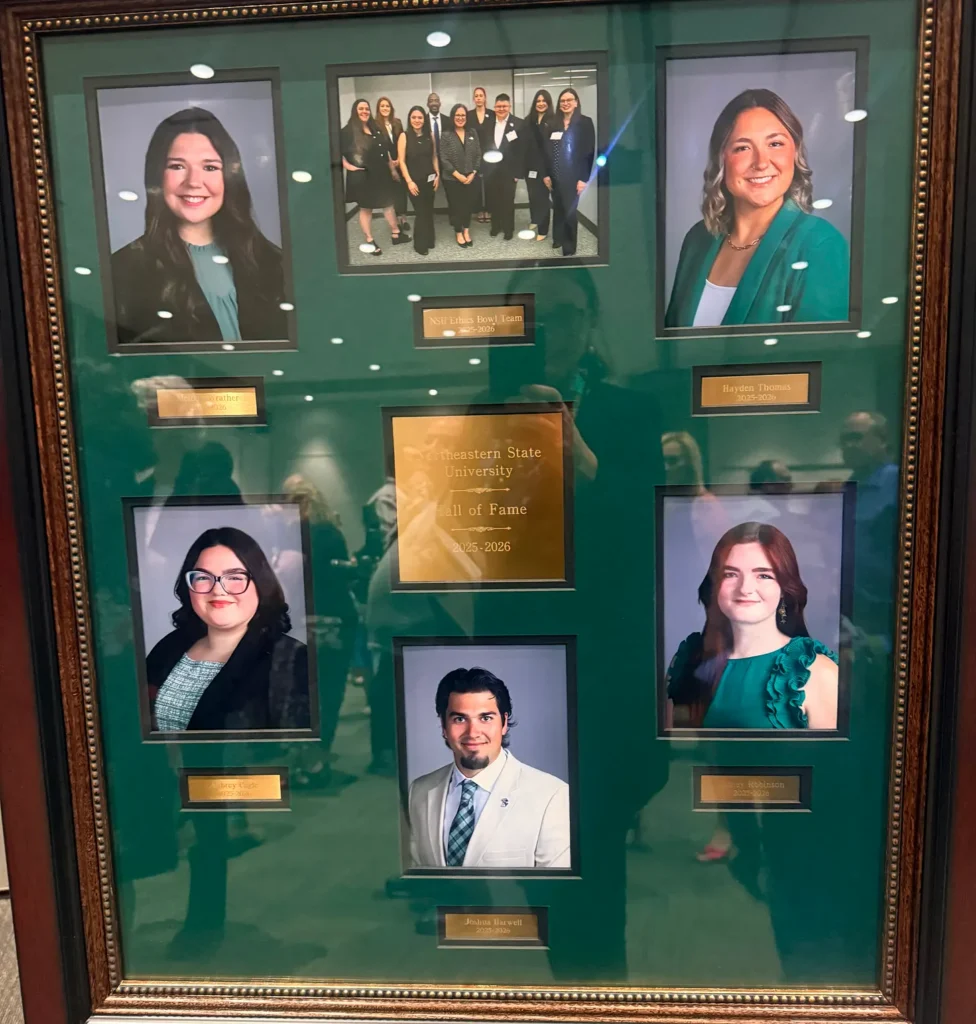
The team was also inducted into the NSU Hall of Fame, a recognition that felt significant not just because of competitive outcomes, but because of everything it took to get there: the long practices, the hard case discussions, the late nights preparing, and the courage it requires to publicly engage some of the most difficult ethical questions facing our world today.
And speaking of courage: at that same end-of-semester ceremony, Gabriela Luna stood up in front of a room of over 200 people and spoke on behalf of the NSU Ethics Bowl team, sharing about her experience throughout the season. For many people, that kind of moment would feel overwhelming. For Gabriela, it was a testament to everything she had grown into over the course of the year. She was poised, articulate, and genuine, and she was absolutely outstanding. Watching her own that room was one of the proudest moments of the entire season for me.
That is what this competition does. The confidence it builds in students is unlike anything I have seen developed in a traditional classroom setting. It is earned, embodied, and real. And it shows up not just in competition rooms, but in boardrooms, community meetings, and moments exactly like that one.
People see the competition. They don’t always see what it costs to get there. They don’t see the moments of uncertainty, the conversations where students had to confront their own assumptions, the practice rounds where someone had to learn, in real time, how to regulate the discomfort of having a deeply held belief challenged and respond with grace anyway.
That’s where the transformation happens. Not in the competition room. In the work that makes the competition possible.
Gratitude
I want to give a sincere thank you to Dr. Tena Wooldridge and Dr. Brian Vickers for their foundational work coaching this team in prior years. The culture they helped establish created the conditions for students to keep growing. And to Dr. Rick Wallace, thank you for investing your time and expertise in preparing our students through a mock competition experience this season. That experience gave students the chance to practice under pressure, refine their thinking, and strengthen their communication before the stakes were real.

Experiential learning genuinely takes a community, and I’m grateful for colleagues who show up for students the way these three did.
What I Want People to Take Away
Ethics Bowl teaches students how to listen well, think critically, collaborate across differences, and navigate complexity with wisdom and integrity. It teaches them that staying present in a hard conversation, genuinely hearing someone whose perspective differs from their own, and responding with both conviction and humility, is not weakness. It’s one of the highest expressions of leadership.
The neuroscience is clear: we are more capable of ethical reasoning, creative thinking, and genuine connection when we are regulated, present, and self-aware. Transformational leaders are not simply people who inspire others. They are people who have done the interior work to lead themselves first.
That is what these students learned this year. And I believe it will stay with them far longer than any framework, any ranking, or any award.
In a culture that increasingly rewards outrage and polarization, watching students choose thoughtful dialogue instead gives me real hope.
I’m grateful for this team, this season, and the reminder of why experiential learning matters so much.
How You Can Get Involved
If this resonated with you, I want to leave you with a few invitations.
For educators and institutions: Get connected with the Association for Practical and Professional Ethics (APPE), the national organization behind the High School and Intercollegiate Ethics Bowl. They provide resources, case materials, and competition opportunities for colleges and universities across the country. If your institution does not have an Ethics Bowl team yet, consider starting one. The investment is modest. The return, in student growth, confidence, and ethical formation, is extraordinary. Learn more at appe-ethics.org.
For students: If you are in college and wondering whether Ethics Bowl is for you, the answer is yes. You do not need a background in philosophy. You do not need to be the loudest person in the room. You need curiosity, a willingness to think carefully, and the courage to engage ideas that challenge you. That is it. Find your campus team, show up to a practice, and give it a season. You will not be the same person at the end of it.
For professionals: Here is the one I want you to sit with. We live and work in a culture that has largely forgotten how to disagree well. We have confused volume with validity, confidence with certainty, and winning an argument with being right. The skills Ethics Bowl develops, listening with genuine intent, staying present under pressure, engaging opposing perspectives with intellectual humility and respect, are not just academic exercises. They are the skills that make teams functional, organizations healthy, and communities worth living in.
If you are in a leadership role, ask yourself honestly: does your team know how to disagree with kindness and courtesy? Do they know how to hold a strong position without dismissing the person across from them? Do they know how to stay regulated when a belief they hold is challenged in a meeting room?
If the answer is uncertain, that is worth paying attention to. Ethical leadership is not a soft skill. It is a foundational one. And it can be developed at any stage of a career.
The world does not need more people who can out-argue each other. It needs more people who can sit across from someone they disagree with and still walk away with the relationship, and the dialogue, intact.
That is what these students learned this year. And it is available to all of us.
Dr. Megan Weinkauf, MBA, MAcc | Assistant Professor of Accounting| Northeastern State University